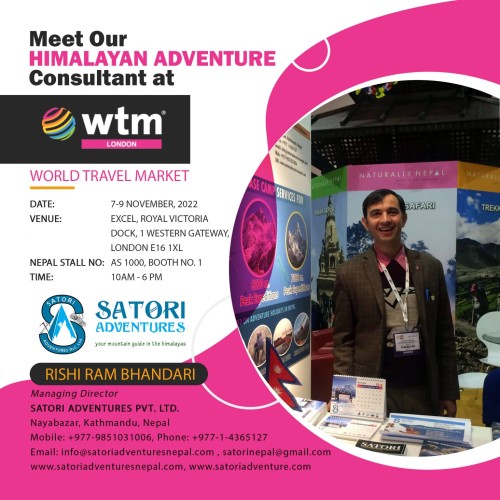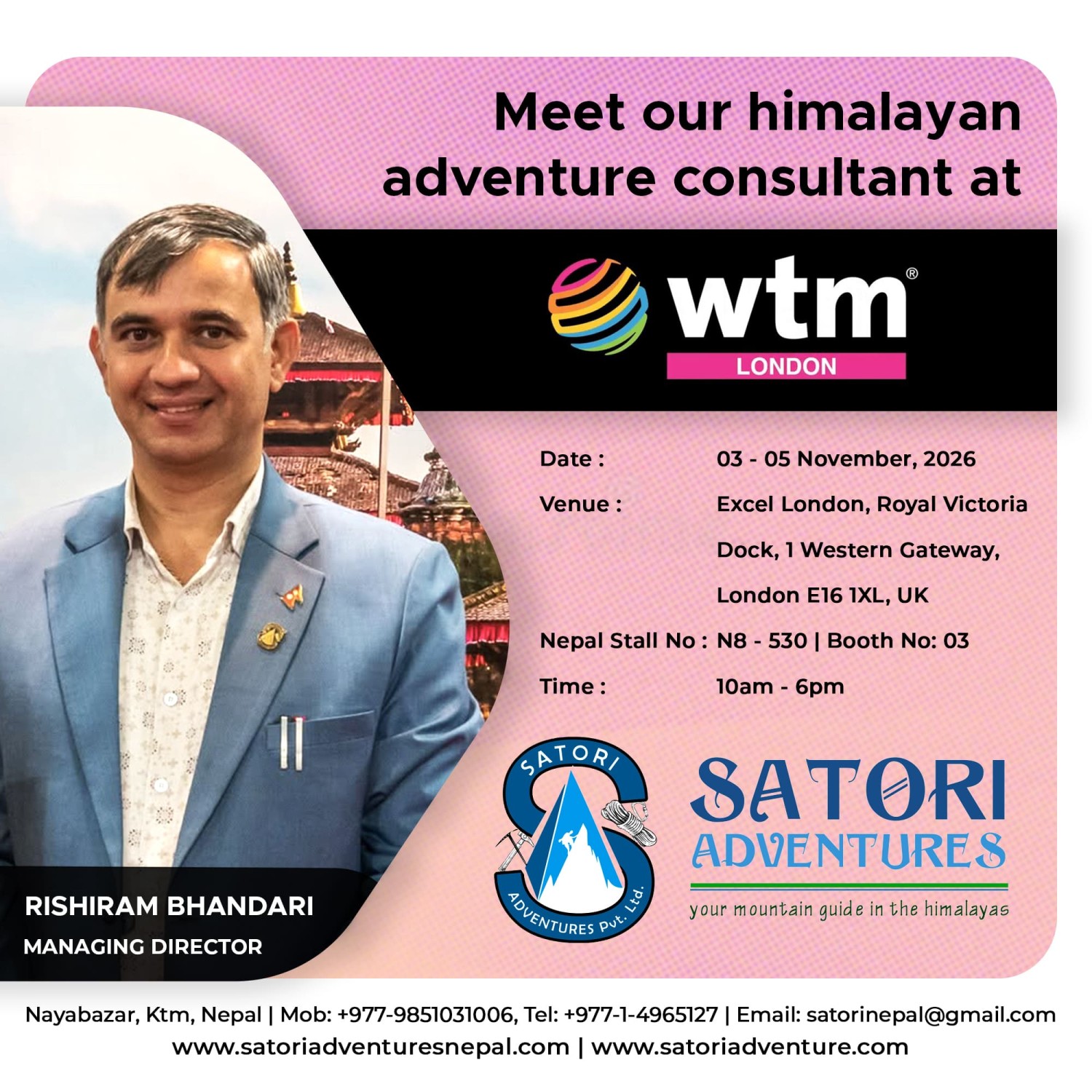
As the international travel industry comes together in London for one of the world’s major tourism events – World Travel Market (WTM), Satori Adventures is pleased to announce its participation in the event, to be held from 03 to 05 November 2026, offering an opportunity to establish partnerships with adventure lovers, adventure specialists, and adventure travel trade partners from UK and the world.
Together, Nepal’s Himalayas and Satori Adventures offer extraordinary adventure programs in the world’s greatest high-altitude adventure playground, where thrilling adventures go hand in hand with living culture and spiritual heritage.
Nepal is well known for its high mountains, but the combination of trekking, mountaineering, cultural experiences, spirituality, relaxing landscapes, and wilderness exploration makes it a unique and must-visit destination.
In this article, we explore how British explorers helped shape the history of Himalayan mountaineering and how, today, Satori Adventures, a Nepalese trekking and mountaineering expedition operator with extensive field experience, helps British adventurers and trekkers explore the Himalayas with professional support, local expertise, and a strong commitment to safety.
British and Nepal Relationships
Nepal has longstanding historical ties with Great Britain. From February 13 to April 3, 1793, Colonel William Kirkpatrick travelled to Kathmandu on behalf of the East India Company on a diplomatic mission. His book, published in London in 1811, is considered the first book on Nepal published in the English language.
In 1801, an agreement was reached between the Kingdom of Nepal and the East India Company to establish a British Residency in Kathmandu. Captain William D. Knox was appointed as the first British Resident, arrived in Kathmandu in April 1802. However, due to differences and disagreements, this arrangement ended and was not re-established until the 1820s.
Brian Houghton Hodgson (1820-1843), who served as a British Resident and Political Officer in Kathmandu researched extensively in the Himalayan biodiversity, Buddhism, ethnography, and Joseph Dalton Hooker (1848-50) were among early British figures who explored Nepal.
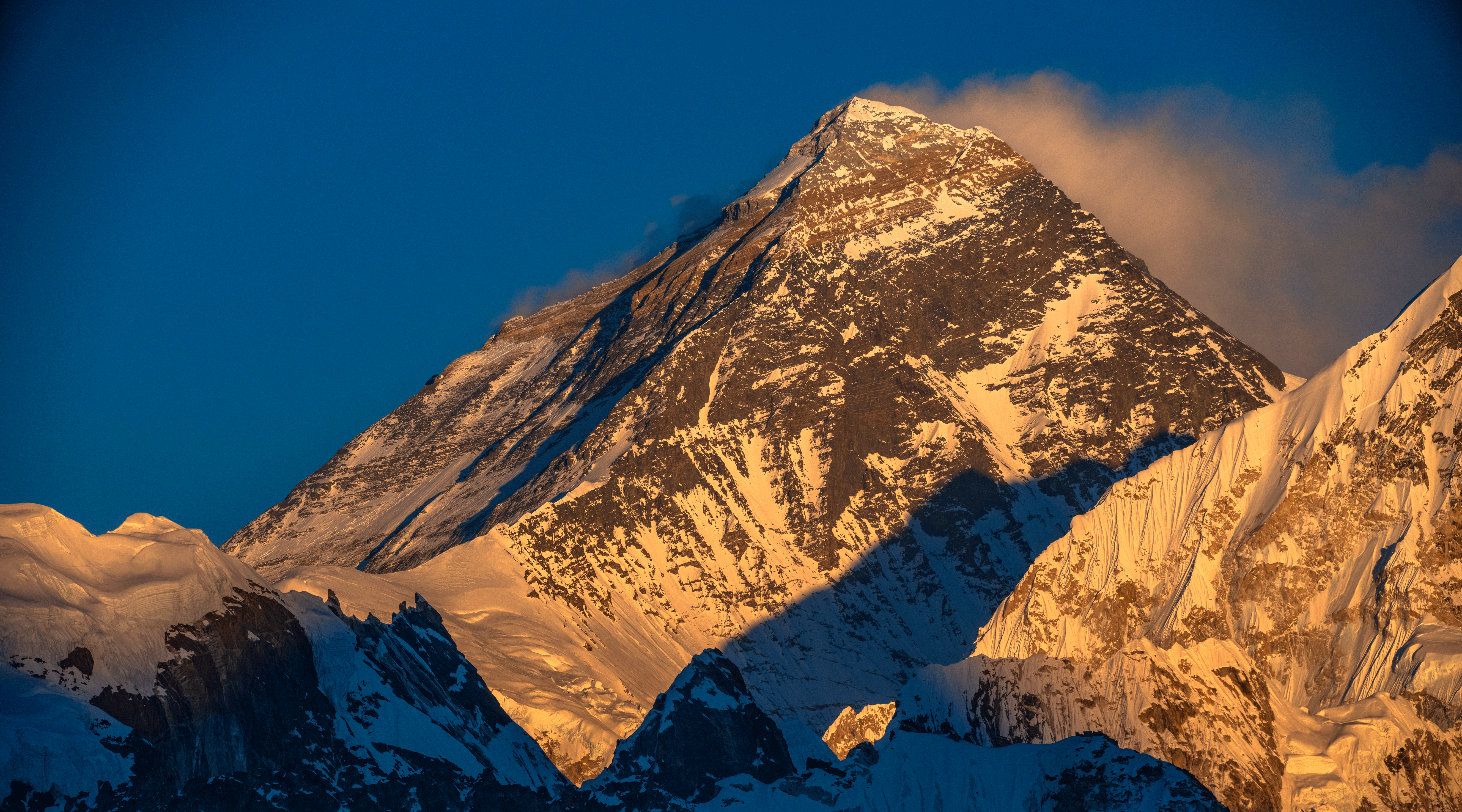
The world’s highest mountain, located in the Nepal Himalayas, was named Mount Everest in 1865 in honor of Sir George Everest, who served as Surveyor General of India from 1830 to 1843. At the time, Nepal restricted access to foreigners, so the mountain was surveyed from distant locations in the Indian plains from 1849-50 and on 6 August 1856, it was officially declared the highest mountain peak of the world. In Nepal, the mountain is widely called Sagarmatha, and Chomolungma (also Qomolangma) is the Tibetan name of the peak.
The very early British visits to Nepal was for diplomacy and trade which in the late nineteenth century changed to scholarly explorations and research. This in the twentieth century changed to Mountaineering.
British Mountaineering Legacy in the Nepal Himalayas
In the late nineteenth and early twentieth centuries, as access to Nepal was restricted, British explorers focused on the Karakoram and Indian Himalayas. During the 1890s, Francis Younghusband and Martin Conway explored the Gilgit, Hunza, and Baltoro regions. Later, Frank Smythe, Eric Shipton, and R. L. Holdsworth explored the Garhwal Himalaya and made the first ascent of Kamet Peak (7,756 m) in 1931, then one of the highest mountains ever climbed.
In July 1937, Jack Gibson and John Martyn, accompanied by a young Sherpa named Tenzing Norgay, explored Bandarpunch I (6,316 m). In June 1950, a team including Gibson, Sergeant Roy Greenwood, Tenzing Norgay Sherpa, and other Sherpa and Indian climbers returned under the leadership of Major General Harold Williams and on 20 June, Tenzing Norgay, three years before his historic Everest ascent, Sherpa Kin Chok Tshering, and Sergeant Roy Greenwood reached the summit of Bandarpunch.
In 1955-56, Sir Peter Holmes and his British team explored the Spiti region and Tatang Tower in Himachal Pradesh, while other British climbers explored the Nanda Devi Sanctuary. Between 1899 and 1950, British climbers and explorers, including Douglas Freshfield, Dr. Alexander M. Kellas, Harold Raeburn, C. G. Crawford, Hugh Boustead, C. R. Cooke, John Hunt, Gilmour C. Lewis, and John W. R. Kempe, explored Kangchenjunga and its associated glaciers in the eastern Himalayas.
With Nepal closed to foreigners before 1950, British climbers also attempted Mount Everest from the Tibetan (northern) side, as well as Kangchenjunga. The first organized exploration of Mount Everest was the 1921 British Mount Everest Reconnaissance Expedition, led by Lieutenant-Colonel Charles Howard-Bury, with George Leigh Mallory as lead climber. Further pre-war British expeditions followed in 1922, 1924, 1933, 1935, 1936, and 1938, culminating in the Seventh British Expedition.
Following Nepal's political change in 1950, foreign explorers and climbers began undertaking their explorations and climbing attempts from the Nepalese side.
Harold William (Bill) Tilman (1898-1977) explored the Langtang, Ganesh Himal, and Jugal Himal regions of central Nepal in 1949, crossing a high Himalayan pass (5,320 m), now popularly known as ‘Tilman La’ or ‘Tilman Pass’.
In May-June 1950, Tilman led an exploratory expedition to the Annapurna region, with Colonel D. G. Lowndes, Major J. O. M. Roberts, Dr. C. H. Evans, J. H. Emlyn Jones, and W. P. Packard. The team explored the north side of Manaslu before reaching the Annapurna region, where they unsuccessfully attempted Annapurna IV (7,525 m). He became the first foreign explorer to cross several high passes in the Annapurna region, including Mustang La / Teri La and Thorong La / Thorong Bhanjyang. Today, Thorong La is one of the most popular and sought-after high Himalayan passes among trekkers.
In September, Tilman travelled with Charles Houston to the Khumbu region to reconnoitre a possible southern approach to Mount Everest.
In 1951, Eric Shipton led an expedition to Mount Everest to search for a practicable route to the summit. Its members included W. H. Murray, T. Bourdillon, M. Ward, and H. E. Riddiford, with New Zealander Edmund Hillary joining later. And, in 1952, after Everest climbing permission was granted to a Swiss expedition, the British turned their attention to Cho Oyu under Shipton's leadership and used the expedition for scientific research into high-altitude equipment.
Many peaks of Nepal Himalayas, were first climbed by British-led expeditions. The most notable was Mount Everest in 1953, led by John Hunt, although the first climbers to reach its summit were Tenzing Norgay, a Nepali Sherpa, and Edmund Hillary, a New Zealander.
Colonel James Owen Merion Roberts (1916-1997), a British Army officer and known as Jimmy Roberts, participated in Tilman's 1950 expedition to the northern side of the Annapurna range and delivered oxygen supplies for the 1953 British Everest Expedition. In 1953, he made the first ascent of Mera Peak (6,476 m) with Sen Tenzing Sherpa. He later led the British-Nepalese-Indian Expedition that made the first ascent of Annapurna II (7,937 m) in 1960. Roberts also made the first ascents of Putha Hiunchuli (7,246 m) in 1954 and Mardi Himal (5,553 m) in 1962.
Other notable first ascents by British climbers included Kangchenjunga (8,586 m) in 1955, Singu Chuli (6,501 m) in 1957, and Nuptse (7,855 m) in 1961. Ama Dablam (6,812 m) was also first climbed by an expedition that included British climber Michael Ward, alongside other international members, as were many smaller peaks across the Nepal Himalayas.
The Continuing British Legacy in the Himalayan Mountaineering
Colonel Jimmy Roberts, mentioned earlier, was stationed at the British Embassy in Nepal as a Military Attache in 1958. He remained in Nepal after his retirement in 1962 from the Army, and established a travel company in 1964, which remained the only travel company in Nepal for the next few years.
In 1965 (the exact season remains unconfirmed), his Mountain Travel organized its first trek to the Everest region for three American women, involving extensive logistical arrangements as there were no hotels and lodges like of today. This marked the beginning of commercial trekking in the Nepal Himalayas.
In 1980, Jimmy Roberts helped design new trekking routes around Pokhara, including the trek undertaken by the Prince of Wales that year. Prince Charles, now King Charles III, visited Nepal from December 6 to 12, 1980, and completed a three-night, four-day trek through the foothills of the Annapurna region. This scenic and relatively less strenuous route later became widely known as the “Royal Trek”.
Not only in the history of early exploration in the Nepal Himalayas, but also in the modern era, Nepal-born and naturalized British citizen Nirmal Purja popularly known as “Nims Dai”, who served in the British Army’s Brigade of Gurkhas and later joined the Royal Navy’s elite Special Boat Service (SBS) in 2009, established extraordinary records in the history of mountaineering.
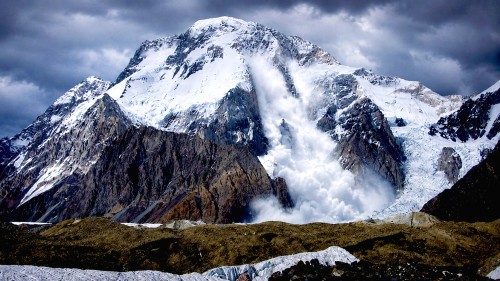
In 2016, he climbed Mount Everest, and in 2017, he led a team of 13 Gurkhas to Everest to commemorate 200 years of Gurkha service to the British Army. In 2018, he left military service to pursue his mountaineering ambitions. In 2019, under his ambitious “Project Possible,” he climbed all 14 of the world’s 8,000-metre peaks in six months and six days. His remarkable achievements include participating in the first winter ascent of K2 in 2021 and completing ascents of all 14 eight-thousanders without supplementary oxygen in 2024 and others. Tragically, he was killed in an avalanche in Pakistan’s Broad Peak in July 2026.
Satori’s Proven Excellence and Supports to British Adventurers in the Himalayas
Satori Adventures has contributed to some mountaineering milestones and first ascents. In 2019, three Georgian climbers, Archil Badriashvili, Tepnadze Giorgi, and Bakari Gelashvili, made the first ascents of the previously unclimbed Panpoche II (6,504 m) on September 23 and Panpoche I (6,620 m) on October 3. Located approximately 15 kilometers northeast of Mount Manaslu, both peaks were opened for climbing in 2014. ( Read more).
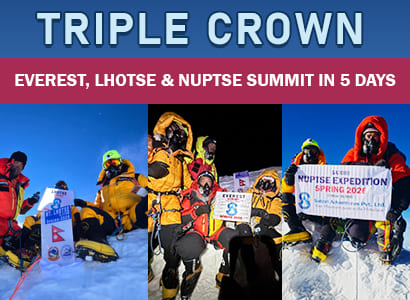
In another milestone, Satori managed the first successful ascent of Nagpai Gosum II (7,296 m) by German mountaineer Jost Kobusch, who reached the summit solo from Camp II at 10:25 am on October 3, 2017. More recently, in Spring 2026, Dr. Ngo Hai Son and Satori Sherpa guide Nima Sherpa completed the Everest-Lhotse-Nuptse Triple Crown in just 98 hours and 27 minutes, an exceptional endurance challenge requiring continuous exposure to the Death Zone. ( Read more).
According to the Himalayan Database figures, British climbers have recorded 573 summits of Mount Everest, including 102 between 2020 and 2026; 535 summits of Ama Dablam, including 134 in the last seven years; and 43 ascents of Himlung Himal, including 27 between 2020 and 2025. These figures reflect growing British participation in Nepal's major Himalayan climbing destinations.
Since its establishment, Satori Adventures has organized numerous climbing, mountaineering, and trekking programmes for British clients. 54 British climbers climbed with Satori on peaks including Everest, Lhotse, Ama Dablam, Makalu, Kangchenjunga, Manaslu, Baruntse, Cho Oyu, Himlung, Putha Hiunchuli, Lobuche Peak, Island Peak, Mera Peak, Chulu West, and Dhamups Peak and other smaller peaks.
Among the British mountaineer’s adventure supported by Satori Adventures is Matthew Kevin Le Voi, an expedition leader and outdoor instructor with over a decade of experience in the adventure industry, who successfully summited Manaslu in 2024 with Satori. This was his first big 8,000m in the Nepal Himalayas. In 2019, Satori organized a Manaslu expedition for Jessica Eliot Hepburn, a British mountaineer and award-winning author who later became the second woman and 14th person in history to complete the Pond to Peak Challenge, combining an English Channel swim with a successful Mount Everest summit in 2022. Although her 2019 Manaslu expedition ended without a summit, the experience provided valuable lessons and strengthened her determination for subsequent achievements.
Satori Adventures has also worked closely with record-breaking mountaineer Nirmal Purja on expedition logistics, and climbing operations across several mountains. This collaboration included some of his successful ascents, including Makalu I in 2023.
Few climbers supported with Satori Adventures’ management to note were Neil Adrian Denis Laughton, Tristan Marcus Blanchard, Graham Anthony Covington, Stephen Christian Ashworth, Marcus John Childs, Charlene Chambers, Dean Mark Maher, Neil Mark Ward, Wood Jonathan Michael, Jamie Andrew Jonathon Morton, Mark Simon Wood, Peter Laurence Bradley, Farid Razavi Mehr, Craig Anthony Wiltshire, Giles Benedict Fairmann, Meriel Briony Davis, Paul Daniel Clarke, Timothy David Maw, Richard Anthony Wilson, Gian Luca Rattacaso, Christian Alfred Julius Kober and many others across these peaks.
Beyond mountaineering and major expeditions, Satori has organized a wide range of Himalayan trekking programmes, from easy walks to strenuous high-altitude journeys to British trekkers. These include the Everest Base Camp Trek, Three High Passes Trek (Renjo La, Cho La, and Kong Ma La passes in the Everest region), Annapurna Circuit, Annapurna Base Camp, Manaslu–Tsum Valley, and Kanchenjunga Circuit treks, among others.
Over the years, Satori has welcomed hundreds of British hikers and trekkers to Nepal through individual and group programmes, while maintaining long-standing partnerships with UK-based adventure and trekking companies.
Why Satori at WTM matters to British Adventurers
Satori Adventures is pioneering adventure company from the Nepal Himalayas, brings together the spirit of exploration, authentic Nepalese hospitality, and professionally organized mountain adventures.
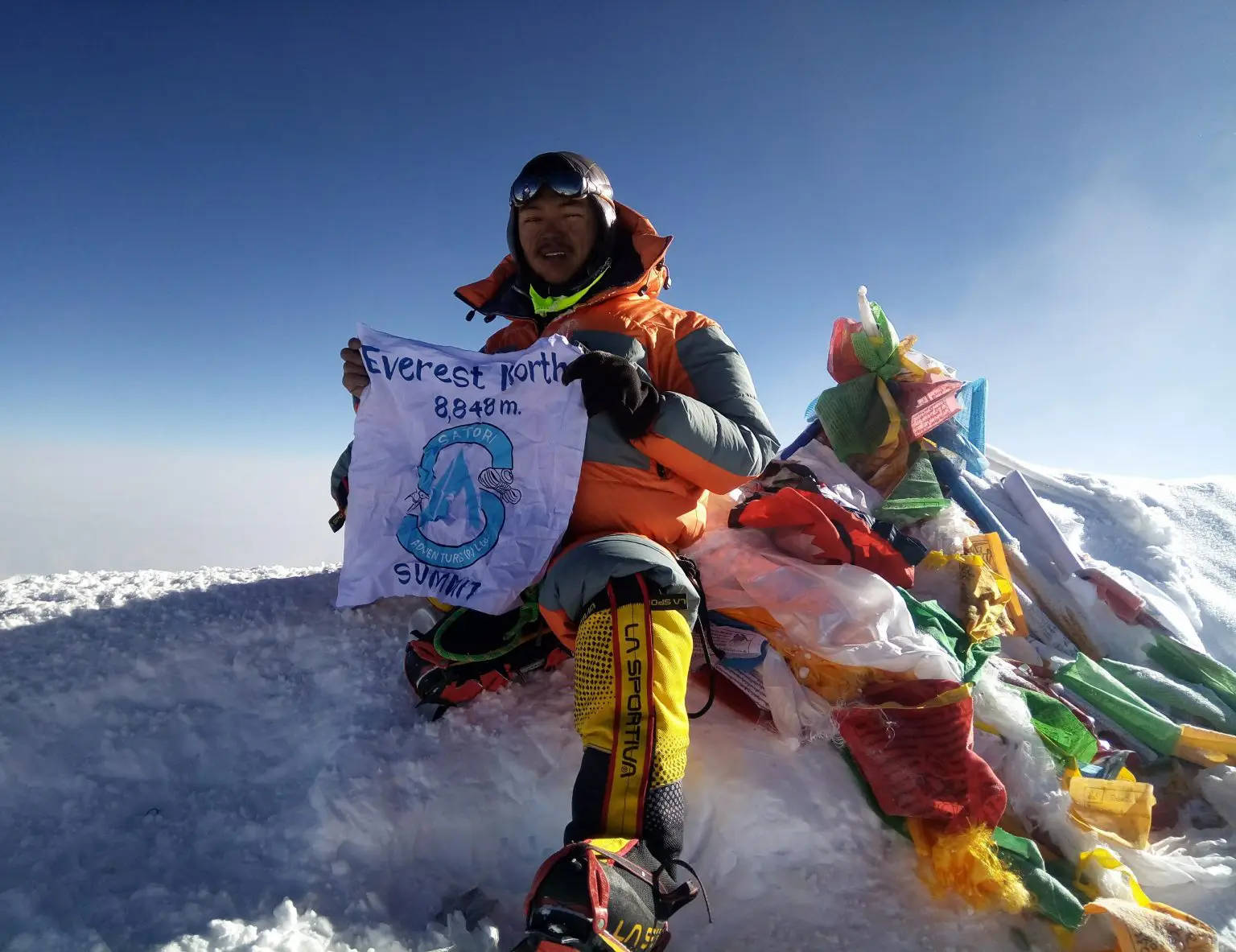
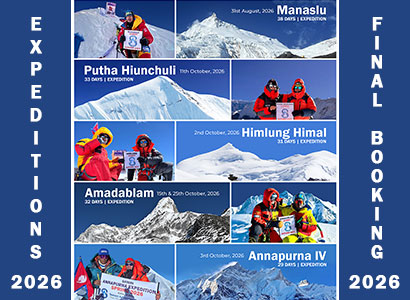
Our adventure trekking and mountaineering programs spans from the legendary Everest Base Camp, Three Passes (high-altitude Himalayan passes), combined Everest region trekking with climbing peaks such as Island Peak, and Lobuche Peak and others. We organize expeditions to Nepal’s iconic 8,000m peaks including Everest, Lhotse, Dhaulagiri, Makalu, Manaslu, Cho Oyu, Kangchenjunga, Annapurna and others as well as other famous peaks like Nuptse, Ama Dablam, Himlung Himal, Putha Hiunchuli, Annapurna II-IV and peaks all over Nepal Himalayas, Indian Himalayas, and Karakoram.
What makes us different in the industry is our strong commitment and philosophy of ‘Safety Before Summit Success” served with 1:1 guide-to-client/climber ratio, careful expedition planning, weather monitoring through US and Europe based forecasting services, arrangement of emergency communication and quick response on emergency, and all led by experienced leadership. We have strong pool of highly experienced Sherpa guides who has built their exceptional knowledge in the mountain since their birth, with technical training, and long experiences on climbing, guiding, route opening, and rope fixing.
For our trekking programmes, our high-altitude Sherpa guides bring exceptional mountain knowledge and extensive climbing experience. They are equipped to use ropes in emergencies and on difficult high-altitude passes. Our guides also carry oxygen cylinders and masks to provide emergency assistance when needed. These additional safety measures make the trekking experience safer and more reassuring, while adding an extra level of professional support throughout the journey.
Today, you do not have to explore the Himalayas as early British explorers did in the early twentieth century. With Satori Adventures, you are well supported and taken care of by an experienced team throughout your Himalayan adventure.
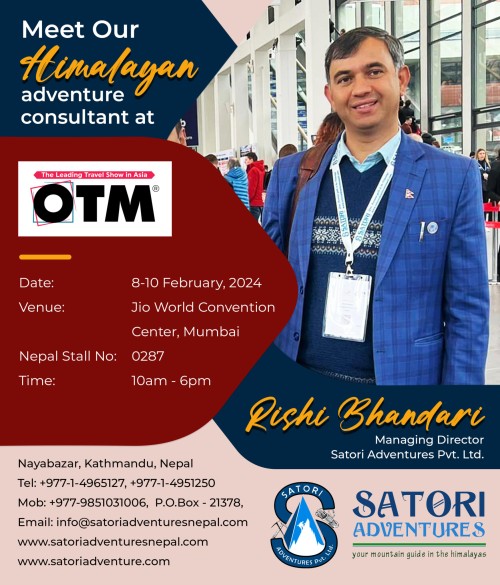
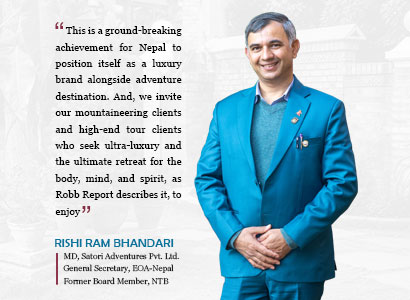
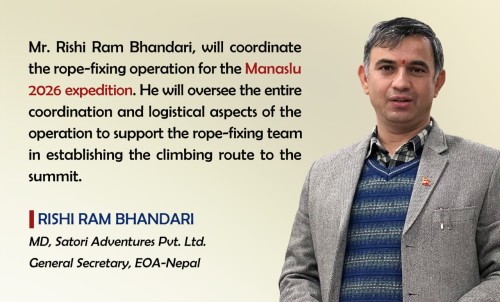
Meet Satori Adventures’ MD Rishi Ram Bhandari at WTM
You can trust Satori for Safety, Expertise and Responsible Himalayan Travel, backed by our proven track record and extensive experience gained through years of hands-on work in the Himalayas. Satori’s leadership also actively contributes to the development of Nepal’s mountain tourism industry through its Managing Director’s roles as a Board Member of the Nepal Tourism Board (2024-2027), appointed by the Government of Nepal through a decision of the Council of Ministers, and as the elected General Secretary of the Expedition Operators Association of Nepal (EOA-Nepal).
With almost three decades of experience managing and organizing expeditions and adventures in the Indian, Tibetan and Nepalese Himalayas, as well as the Karakoram, Satori Adventures’ Managing Director, Rishi Ram Bhandari, brings extensive field experience and professional expertise to the organization.
Currently serving his second term as the elected General Secretary of EOA-Nepal, he oversees one of the most crucial roles in expedition management in the Himalayas. Recently, in his capacity as General Secretary of EOA-Nepal, he has played an important role as Rope-Fixing Coordinator on mountains such as Manaslu, Ama Dablam, Himlung and others. His work extends beyond expedition management to improving climbing safety, supporting Sherpa climbing teams, coordinating with government authorities, and promoting responsible and sustainable mountaineering in Nepal.
At WTM, 03-05 November 2026, we invite you to meet Satori Adventures’ Managing Director, Rishi Ram Bhandari, and explore opportunities to experience the Himalayas with a trusted Nepalese adventure operator.
We invite young British adventurers and explorers to follow in the footsteps of previous generations, continue the proud legacy of Himalayan exploration, and create new chapters in mountaineering history. According to the Government of Nepal, there are still 102 unclimbed mountain peaks of varying heights (as of Spring 2026) which are opened for climbing, offering new opportunities for exploration, first ascents, and extraordinary Himalayan adventures. With Satori Adventures’ local knowledge, experienced Sherpa climbing teams, and professional expedition support, the next generation of British adventurers can become part of this continuing Himalayan legacy.