The Great Himalayan Giants Await: Join Epic Autumn Expeditions 2026 with Satori Adventures
Due to variations in altitude, terrain, and geographic location, the Himalayan peaks experience diverse weather conditions. As a result, different peaks are best climbed in different seasons to ensure safety and increase the chances of a successful ascent.
Spring 2026 Season in Review
Satori Adventures, a leading homegrown expedition company specializing in high-altitude expeditions, peak climbing, and remote trekking, has successfully concluded an outstanding Spring 2026 season marked by remarkable achievements.
With nearly two decades of experience in professional expedition management and a strong commitment to ethical practices, we have earned the respect and trust of the global mountaineering community. Guided by our philosophy of “High Success and High Safety,” we attract climbers and adventurers from around the world each year.
And, we are proud of our exceptional safety record and near 100% success rate, achieved through personalized service, small expedition group sizes, a 1:1 climber-to-Sherpa guide ratio, highly trained and experienced Sherpa teams, and premium logistical support.
This Spring 2026 season, Satori Adventures welcomed a diverse range of climbers, from ambitious first-time expedition participants to world-class elite mountaineers. Our teams successfully climbed many iconic peaks of the Himalayas, including Mount Everest (8,848.86 m / 29,031 ft), Kanchenjunga (8,586 m / 28,169 ft), Lhotse (8,516 m / 27,940 ft), Dhaulagiri I (8,167 m / 26,795 ft), Annapurna I (8,091 m / 26,545 ft), Nuptse (7,861 m / 25,791 ft), and Ama Dablam (6,812 m / 22,349 ft). Climbers also took on several renowned 6,000-meter peaks, including Mera Peak (6,476 m / 21,247 ft), Island Peak (6,189 m / 20,305 ft), and Lobuche East (6,119 m / 20,075 ft), among others.
For most of the 8,000-meter peaks mentioned above, spring conditions are generally more favorable. For example, on Mount Everest during the spring season, the severe winter winds begin to ease, while the monsoon has not yet arrived. Winter snow also compacts into firm, stable ice, helping to make the climbing route more secure.
Why Autumn is Another Excellent Climbing Season
But for many mountains in the Himalayas, the autumn season is considered the best, such as Manaslu and Ama Dablam, for example. In contrast to Everest, Ama Dablam experiences more stable weather conditions in autumn due to its lower altitude, its position below the main jet stream, and its natural protection from higher surrounding peaks like Makalu, Lhotse, Nuptse, and Everest.
The risk of avalanches on Ama Dablam is also lower in autumn compared to other seasons, and as the jet stream shifts northward, climbing its knife-edge ridges becomes relatively less severe.
On Mount Manaslu as well, autumn brings more stable weather, with more predictable snowfall and a northward shift of the jet stream that reduces extreme winds on the upper exposed ridges. Additionally, the snowpack tends to be more settled during the autumn season. In contrast, during spring, persistent jet stream winds, heavy snowfall, and rising temperatures can create significantly higher avalanche risks.
For peaks below 7,000 meters, conditions in both autumn and spring are generally more or less similar. Therefore, if you are aspiring to climb smaller peaks as an entry-level introduction to mountaineering in the Himalayas, either of these seasons can be a good choice.
Post-monsoon landscapes, where forests and valleys display rich green and golden tones, along with clear skies, stable weather patterns, crisp alpine breezes, moderate temperatures, and excellent mountain visibility, are typically experienced from September through November. This makes the period highly enjoyable for trekking to base camps as well as other Himalayan journeys.
Apart from excellent climbing conditions and trekking routes, the autumn season also coincides with Nepal’s most celebrated cultural festivals: Dashain, Tihar, and Chhath. This period offers climbers a unique opportunity of combining exceptional mountaineering activity with unforgettable cultural immersion (if you are around the cities by festival time), experiencing Nepal’s rich spiritual traditions and once-in-a-lifetime moments in the mountains.
Explore Satori Adventures’ Autumn Expedition Programs
While the focus of climbers in spring is on Mount Everest – the highest peak in the world, where the largest concentration of Sherpa climbers, logistics, and support facilities is deployed, the autumn season benefits from an excellent reserve of experienced Sherpa climbers and strong logistical management across other major Himalayan peaks. We list here some of the best autumn climbing programs for you, in addition to our regular 6,000-meter peak climbing expeditions.
Mount Manaslu (8,163m) – The Spirit Mountain
Mount Manaslu, at 8,163 m (26,781 ft), is the eighth-highest mountain in the world and is regarded as one of the most serious and challenging 8,000-meter expeditions in the Himalayas.
Known as the "Mountain of the Spirit" Mt. Manaslu was first successfully climbed on May 9, 1956, by a Japanese expedition led by Toshio Imanishi and Gyalzen Norbu Sherpa. Climbing Mount Manaslu is an extreme adventure recommended for climbers with previous mountaineering experience on 6,000-meter or 7,000-meter peaks, and it is widely considered an excellent stepping stone toward more challenging objectives such as Mt. Everest, K2, Dhaulagiri, or even all fourteen 8,000-meter peaks.
You may choose Mt. Everest for the fame that comes with standing on the highest point on Earth, but climbing Manaslu is often described as a journey of self-discovery and something profoundly personal, where you test not only your endurance but also your mental resilience, decision-making ability, and capacity to perform under extreme conditions.
Mt. Manaslu is located in remote Gorkha, where it rises as a massive glaciated pyramid surrounded by deep valleys. The approach route in the post-monsoon season is especially beautiful, with green and golden landscapes, clear blue skies, and occasional white clouds.
Satori Adventures organizes autumn season Manaslu expeditions each year and has earned an excellent reputation and trust through nearly two decades of continuous effort and experience. Guided by our philosophy of “High Success and High Safety,” we are widely recognized for our strong safety record, high summit success rates, small and personalized expedition groups with a 1:1 climber-to-Sherpa guide ratio, highly experienced Sherpa guides, carefully designed itineraries, and premium logistics and meals.
Book your seat at the earliest for our autumn Manasalu expedition 2026. Find more detailed information about the expedition in our comprehensive FAQs section.
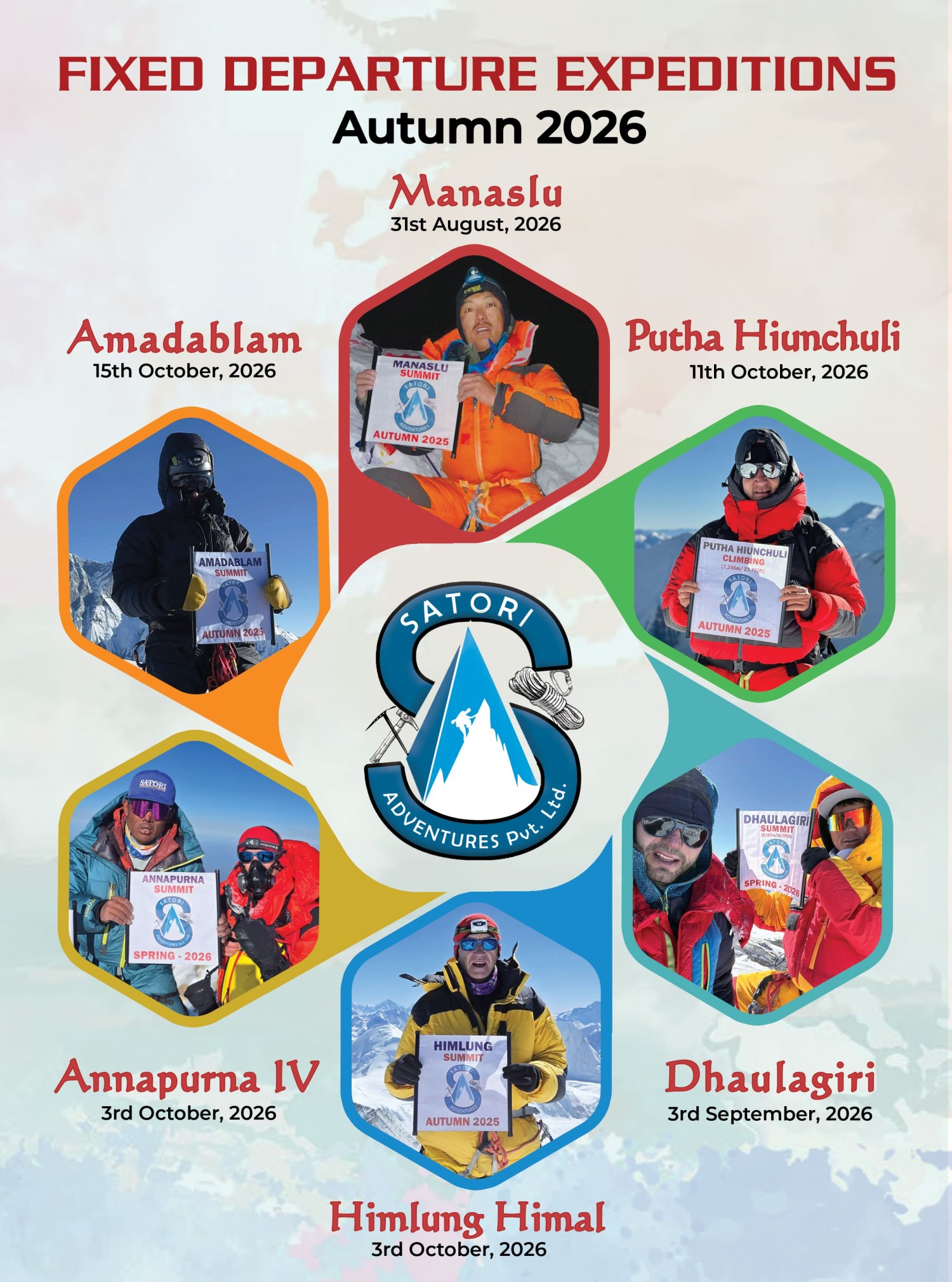
Manaslu Autumn Date: Aug 31, 2026
Dhaulagiri I (8,167m) – The White Mountain
Mount Dhaulagiri (8,167 m / 26,795 ft), known as the “White Mountain,” is the seventh-highest mountain in the world and is also regarded as one of the most technically demanding and serious 8,000-meter expeditions in the Himalayas, even more so than Manaslu. Mt. Dhaulagiri was first successfully climbed on May 13, 1960 by a Swiss-Austrian expedition team including Kurt Diemberger, Peter Diener, Ernst Forrer, Albin Schelbert, Nyima Dorji Sherpa, and Nawang Dorji Sherpa.
Although Mount Everest is higher, it is generally less demanding from a technical standpoint than Mount Dhaulagiri. Climbing Dhaulagiri is not about commercial success, but about true mountaineering and a test of endurance and mental resilience in extreme conditions.
As the climbing is extreme, technical, and demanding, we recommend you to wait until you have climbed other 7,000m or 8,000m peaks. You may alternatively consider Himlung Himal or other 6,000-meter peaks to begin your Himalayan climbing journey if you have not done so yet.
Mt. Dhaulagiri is located in the remote western region of Nepal, rising dramatically above the Kali Gandaki Valley as a massive, isolated, ice-covered pyramid. The approach route in the post-monsoon season is exceptionally scenic and remote, passing through deep gorges, rugged wilderness, and pristine high-altitude landscapes with breathtaking views of surrounding peaks. However, the climbing conditions are characterized by colder weather compared to spring.
We organize Dhaulagiri expeditions in both spring and autumn each year and have built a strong reputation through nearly two decades of continuous experience and dedication in Himalayan mountaineering. We are widely recognized for our strong safety record, high summit success rates, small and personalized expedition groups with a 1:1 climber-to-Sherpa guide ratio, highly experienced Sherpa guides, carefully designed itineraries, and premium logistics and meals.
Join our trip before the seats are filled. Find more detailed information about the expedition in our comprehensive FAQs section.
Dhaulagiri Autumn Date: Sep 3, 2026
Himlung Himal (7,126m) – Best Stepping Stone for 8,000m climbing
Nepal is home to some of the world’s highest mountains, including eight peaks above 8,000 meters and hundreds of peaks in the 6,000 and 7,000-meter range. In total, 414 peaks are officially open for climbing, among which around 75 are 7,000-meter peaks. And, thus renowned for high-altitude mountaineering. Climbers use 7,000 meter peaks as preparation for more demanding expeditions in the Himalayas, including Mount Everest.
Himlung Himal is one of the more frequently climbed 7,000-meter peaks due to its relatively straightforward access (by Himalayan standards) and is the most climbed as a training climb for higher objectives. The peak has gentler slopes of around 35-45° and follows a straightforward route, with a long summit day of about 10-12 hours.
Climbing this peak is not about commercial success or fame like other 8,000m, but about gaining essential high-altitude experience, improving technical skills, and testing endurance and mental resilience in a true Himalayan environment.
Mt. Himlung Himal is located in the remote Nar–Phu Valley near the Tibetan border, offering an untouched and culturally rich landscape. The approach trek is exceptionally scenic, passing through ancient villages, deep gorges, barren high-altitude terrain.
Autumn is considered the best season to climb Himlung Himal due to its stable snow conditions. From the summit, you are rewarded with breathtaking panoramic views of the Annapurna Range, Manaslu, and the vast Tibetan Plateau.
Satori Adventures organizes Himlung Himal expeditions each year, earning a strong reputation for safety, high summit success rates, and personalized service. The company operates with small, carefully managed groups, a 1:1 climber-to-Sherpa ratio, highly experienced Sherpa guides, well-planned acclimatization schedules with multiple high camps, and premium logistics and meals, making the expedition both safe and well-supported.
Join our Himlung Himal Autumn 2026 expedition trip. Find more detailed information about the expedition in our comprehensive FAQs section.
Himlung Himal Autumn Date: Oct 3, 2026
Putha Hiunchuli (7,246m) – The Gateway to 7,000 Meters
Putha Hiunchuli (7,246 m / 23,772 ft) is located in the far western part of the Dhaulagiri range and is considered the last major 7,000-meter peak within the Dhaulagiri massif. Often referred to as Dhaulagiri VII, it stands as a relatively isolated and less-visited peak compared to other major Himalayan expeditions.
The mountain lies in the remote Dolpo region of Nepal, a culturally rich area where ancient Bon traditions and Tibetan Buddhism are still actively practiced, offering climbers a rare blend of high-altitude wilderness and authentic Himalayan culture far from the crowded trails of Everest and Annapurna. Due to its remoteness and demanding approach, Putha Hiunchuli sees relatively few ascents – approximately 380 to date – making it a true wilderness expedition in the Himalayas.
Putha Hiunchuli is considered a non-technical 7,000-meter Himalayan peak and one of the more achievable high-altitude climbs in Nepal. The route generally involves moderate snow slopes of around 25-35°, limited crevasse exposure, and minimal rock climbing sections. This peak is often categorized in the PD to PD+ alpine grading (Peu Difficile to Peu Difficile Plus).
Although technically less demanding, the expedition still requires strong physical endurance, mental resilience, and solid high-altitude fitness, as it lies in a region surrounded by some of the world’s most challenging Himalayan terrain. For safety and success, prior experience in high-altitude trekking and basic skills in rock, snow, and ice climbing are highly recommended, as the climb typically involves the use of crampons, harnesses, ice axes, fixed ropes, and Jumar ascenders, along with glacier travel and ascent of snow and ice slopes.
For those without prior technical experience, a guided Putha Hiunchuli expedition with Satori Adventures is the best choice, which is supported by experienced Sherpa guides who provide training, instruction, and full support throughout the climb, ensuring proper preparation and safety in the mountains.
Join our Putha Hiunchuli Autumn 2026 expedition trip. Find more detailed information about the expedition in our comprehensive FAQs section.
Putha Hiunchuli Autumn Date: Oct 11, 2026
Ama Dablam (6,812m) – The Technical Masterpiece
Ama Dablam (6,812 m / 22,349 ft) is one of the most iconic and visually striking mountains in the Khumbu region of Nepal Himalayas. And the peak is known for its elegant pyramid shape, exposed ridges and the most sought-after technical climbing peaks in the world. The peak offers spectacular views of the Mount. Everest, Lhotse, Makalu and surrounding giants.
This peak is considered a technical alpine peak that requires strong mountaineering skills and prior high-altitude climbing experience. The normal route involves steep snow, ice, and rock sections, with sustained climbing on exposed terrain and fixed ropes. Ama Dablam climbing is considered as PD+/AD to D (Peu Difficile Plus to Difficile) climb which includes sections of 40-60° slopes, vertical rock pitches, and challenging ridge climbing.
Ama Dablam is not a beginners peak as it demands perfect mountaineering skills on rock climbing, ice climbing, and exposed ridges. To climb Ama Dablam, strong physical endurance, mental resilience, excellent high-altitude fitness, and prior technical climbing experience is required.
As Ama Dablam is extremely technical and dangerous climb, we recommend you climbing other 6,000m peaks like Island Peak (6,189 m/ 20,305 ft), Lobuche Peak (6,119 m/ 20,075 ft) or Himlung Himal (7,126 m /23,379 ft) as preparation climb.
Satori Adventures provides structured, safety-focused Ama Dablam expeditions with highly skilled Sherpa guides, detailed acclimatization planning, technical training, and full logistical support to ensure climbers are well-prepared for this challenging Himalayan ascent.
Join our Ama Dablam Autumn 2026 expedition trip. Find more detailed information about the expedition in our comprehensive FAQs section.
Ama Dablam Autumn Date: Oct 15, 2026 / Oct 25, 2026
Annapurna IV (7,525m) – The Wilderness Challenge
Annapurna IV at 7,525 m (24,688 ft) is the lowest peak in the Annapurna range, with Annapurna I being the highest at 8,091 m. Despite its comparatively lower elevation, it remains a remote and highly challenging Himalayan peak, offering an authentic expedition-style experience far from commercial crowds.
To date, Annapurna IV has seen only 146 total ascents, and because of this rarity and difficulty, summiting Annapurna IV commands great respect within the mountaineering community. It is best suited for experienced mountaineers seeking a true wilderness ascent.
Mt. Annapurna IV demands expert ice and rock climbing ability, stamina for climbing slopes up to 65° at high altitude, exposed ridges, and excellent decision-making in life-threatening situations. Therefore, extensive prior experience on technical peaks such as Ama Dablam, Baruntse, or Cho Oyu (higher altitude but less technical) is expected.
If you have prior experience on the mentioned mountain peaks, now is the time for you to test your ultimate endurance, and experience the thrill of authentic mountaineering.
Satori Adventures Nepal, with a strong reputation for safety, high summit success rates, and personalized service, operates Annapurna IV expeditions regularly with small and carefully selected groups. The company maintains a 1:1 climber-to-Sherpa ratio, provides highly experienced Sherpa guides, well-planned acclimatization schedules with multiple high camps, and premium logistics and meals, making the expedition both safe and well-supported.
Join our Annapurna IV Autumn 2026 expedition trip. Find more detailed information about the expedition in our comprehensive FAQs section.
Annapurna IV Autumn Date: Oct 3, 2026
Final Reflections
As we prepare for the Autumn 2026 expedition season, we warmly invite all adventure enthusiasts and mountaineers to join our well-structured Himalayan climbing programs across some of the region’s most iconic peaks. Designed with strong logistics, small and personalized teams, and expert Sherpa support, our expeditions ensure both maximum safety and truly meaningful climbing experiences in the heart of the Himalayas.
We bring a diverse range of expedition programs for Autumn 2026, guided by a firm commitment to safe, responsible, ethical, and high-quality Himalayan mountaineering. Whether you aim to climb the technical ridges of Ama Dablam, challenge yourself on the 7,000-meter slopes of Himlung Himal, undertake serious mountaineering on Annapurna IV, or pursue the summit of legendary 8,000-meter giants such as Manaslu and Dhaulagiri I, autumn presents a rare opportunity to turn your Himalayan ambitions into reality.
Autumn in Nepal offers a short but ideal window for climbing these mountain peaks, bringing nature into perfect balance and creating some of the best conditions of the year. With stable weather patterns, clear skies, and excellent summit opportunities, it remains one of the most favorable seasons for Himalayan expeditions.
With the trust and respect, we have earned, guided by our philosophy of “High Success and High Safety,” we warmly welcome climbers and adventurers from around the world. We are proud of our exceptional safety record and near 100% success rate, achieved through personalized service, small expedition group sizes, a 1:1 climber-to-Sherpa guide ratio, highly trained and experienced Sherpa teams, and premium logistical support. We remain fully committed to maintaining and strengthening this standard of excellence in every expedition we operate.
We look forward to welcoming you to Nepal Himalayas this autumn.
Your Himalayan Dream Awaits:Mountaineering is a true test of the human spirit. At Satori Adventures, we transform high-altitude ambitions into safe, well-guided, and successful Himalayan experiences.