1. What is an avalanche?
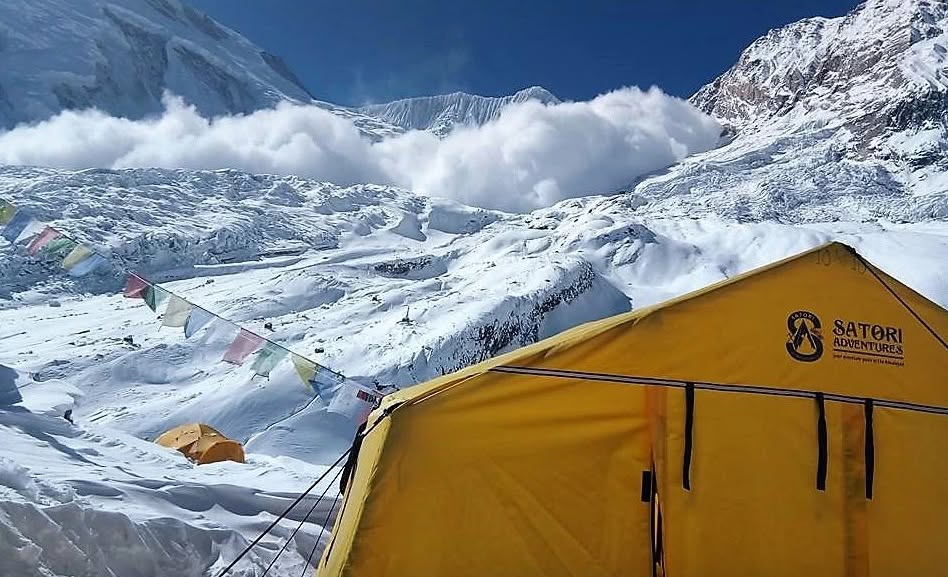
An avalanche, or snow avalanche in particular, is a very rapid flow of snow masses that can include ice, rock, or vegetation on mountain slopes and terrain such as those found in the Nepal Himalayas, the Karakoram, the Andes, the Rockies, the Alps, and other mountainous regions.
Avalanche formation is the result of a complex interaction between terrain, snowpack, and meteorological conditions leading to avalanching (Schweizer, Jamieson, & Schneebeli, 2003).
It is one of the most dangerous natural disasters in the mountains, and avalanches have proved to be extremely dangerous, taking the lives of many people in mountain regions around the world.
2. What causes an avalanche to occur?
Several factors can contribute to an avalanche, and these are generally referred to as ‘triggers’. Natural triggers include heavy snowfall and rapid fresh snow accumulation that can add weight over weak layers within the snowpack or on rough terrain. Wind can also transport and deposit snow, forming unstable slabs, cornices, or overhangs. Sunlight and rain can cause snow to melt, weakening the bonds between snow layers. In addition, ground movement, rock falls, and other natural disturbances can trigger an avalanche.
Sometimes, human activity can also trigger avalanches, as the movement, weight, and vibrations of people can add stress to an already unstable snowpack and destabilize the slope.
3. How many types of avalanches are there?
Although there are several categories of avalanches, two of the most common types are Loose-Snow Avalanches and Slab Avalanches.
Loose-snow avalanches start from a point in a relatively cohesion-less surface layer. These may develop into wet-snow avalanches or dry/powder-snow avalanches (this depends on the level of water the snow carries). In this type, there no large blocks rolling down but the snow dusts.
The ice avalanche is caused by the collapse of glaciers, Seracs, hanging ice blocks, or falling masses of ice from crevasses. Some notable ice/Serac avalanches include the April 1970 Khumbu Icefall collapse on Everest during Japanese Ski Expedition, the Serac-triggered avalanche on Lenin Peak in July 1990 that killed 43 climbers, the Serac collapse at the Bottleneck on K2 that claimed 11 lives, and the Khumbu Icefall Serac avalanche on Everest in April 2014, which killed 16 Sherpas and injured nine others.
Snow slab avalanches occur when a coherent layer, or “slab,” of snow breaks away from the slope and slides rapidly downhill. While loose-snow avalanches release individual snow particles, slab avalanches can release a large, connected section of the snowpack.
Due to various weather conditions and different snowfall events, layers form within the snowpack. In this layered snowpack, some layers are weak while others are stronger. If a weaker layer remains beneath a stronger layer, the stress and weight of the overlying snow can cause a crack to develop in the weaker layer, eventually causing the slab above it to break away.
A wind slab is another type of avalanche formation that occurs when strong winds pick up and transport loose snow from the windward side of a mountain to the leeward side. The transported snow is deposited and compacted, forming a wind slab that can become unstable and trigger an avalanche.
Angela Benavides, in a piece published by ExplorersWeb on 10 August 2026, writes, “The avalanche [the Broad Peak avalanche of 30 July that swept away ten climbers, including Nirmal Purja ‘Nimsdai’] came from a snowy rib located up and to the right of Camp 3. Rather than a slab avalanche, the Broad Peak slide might have been triggered by a cornice or Serac falling from that rib. It was massive and violent enough to sweep the climbers off the normal route.”
4. Where do avalanches happen most frequently?
Avalanches can occur on any mountain slope where snow accumulates. They are not limited to the Himalayas of Nepal and India, the Karakoram of Pakistan, the European Alps, the Rockies of North America, the Andes of South America, or other mountain ranges in Central Asia, Japan, New Zealand, and elsewhere.
Avalanches occur primarily on exposed slopes where snow can accumulate following blizzards and heavy snowfall and the terrain and conditions are prone to avalanches.
In most cases, the average inclination of starting zones ranges from 27° to 50°. On rare occasions, avalanches can start on gentle slopes of less than 25°(Ancey, C. Snow Avalanches). This is because this slope provides favorable conditions for snow accumulation while the gravitational force pulling the snow downhill is significant. Above approximately 45°, it becomes more difficult for thick and continuous layers of snow to accumulate because snow tends to slide or sluff off more frequently. But, this is not the only and the final standard.
5. What is the Process of an Avalanche?
As we mentioned earlier, an avalanche is a rapid downhill flow of snow/ice, and it occurs due to various triggering factors. It is a process as well. This process can be divided into three phases: initiation, motion, and deposition.
When new snowfall occurs and begins to accumulate on the slope at different densities, various meteorological phenomena take place, creating different layers and interfaces within the snowpack. Then the forces acting on the snow exceed the strength of the bonds holding the snowpack together, this is when or where an avalanche is initiated.
The snow/ice/Seracs then released from here and accelerates as it starts to fall/roll downwards, propelled by gravitational forces through the avalanche path or track zone. During this motion, the original mass can entrain additional snow, mud, rocks, etc., and can increase in volume and speed.
Finally, as the slope becomes gentler and the rolling masses lose momentum, the avalanche slows down and eventually comes to rest in the deposition zone. The accumulated snow, ice, and debris are left here.
6. What does an Avalanche Path/ track zone look like?
Generally, an avalanche path consists of three zones: the starting zone, where the snow and ice are released; the transition zone, where the released particles travel downhill; and the deposition zone, where the released snow, ice, and other materials are deposited and accumulated.
In the first zone, due to various triggering factors and mechanisms, stability fails within the snow cover, which is then set in motion, beginning the formation of the avalanche body. In the transition zone, the avalanche reaches its maximum acceleration, the avalanche body undergoes its final formation, and additional snow is partially or fully entrained. In the deposition zone, the avalanche begins to decelerate, snow and other materials are deposited, and the movement of the avalanche body eventually comes to a stop.
The most common are gully avalanche paths. In the Khibiny Mountains, for example, they make up about 80% of all avalanche paths, while flat slopes account for only about 20%. This ratio, or one close to it, is typical of many mountainous regions. Grooves and hollows are also frequently encountered in some regions.
Understanding these zones in the mountains can significantly decrease the risks and fatalities. Avoiding the starting zone, where the release of snow/ice is most likely to initiate, and recognizing steep, snow-loaded slopes and wind slabs can help climbers minimize the risks. Likewise, knowing the avalanche track helps you avoid dangerous routes.
7. Which type of avalanche is the most dangerous?
How dangerous an avalanche is, and which type is the most dangerous, is not an easy question to answer, as the danger of an avalanche may vary depending on its size, destructive potential, speed, depth and volume, terrain exposure (such as campsites and regular climbing routes), and avalanche type.
Among the various types of avalanches, large slab avalanches can release a large amount of snow and involve a combination of a cohesive slab and a weak layer beneath it. These types of avalanches are therefore considered among the most dangerous. This can pose even greater threat depending on the slope of the terrain over which it flows downhill.
Ice/Serac avalanches can also be catastrophic as we listed some examples earlier, followed by wet-snow avalanches. Dry-snow avalanches, if the released mass is not very large, can generally be less dangerous.
Many deadly slab avalanches (as studied or speculated) have occurred in the Himalayas includes the Manaslu avalanche at Camp III in 1972, which took life of fifteen climbers; the Gangapurna avalanche of 1971. And, the Kang Guru avalanche of 2005 which killed 18 members of French expedition team including Sherpas likely to be snow-powder avalanche.
8. Can avalanches be predicted accurately?
The straightforward answer is no. There is nothing about the prediction accuracy. Before answering this, it is useful to understand how avalanche science and techniques have evolved to make avalanche prediction possible somehow.
The development of avalanche science and techniques for protecting against avalanches began in Western Europe in the middle of the 19th century.
The book Avalanches in the Swiss Alps by J. Coaz, published in 1881, was a prominent work in the scientific study of avalanches. Six Alpine nations – Switzerland, France, Italy, Austria, Yugoslavia, and the Federal Republic of Germany (then West Germany) – established a network of stations to forecast avalanche warnings through radio and television under the European Avalanche Warning Services (EAWS) in the early 1980s.
Although avalanches cannot be predicted accurately in terms of where and when they will occur, avalanche danger can be forecast by analyzing weather conditions, snowpack structure, terrain, and other indicators.
In other words, avalanche forecasting is about identifying potentially unstable snowpack, assessing how likely a release may be, and determining how large and destructive the avalanche could be.
McClung lists three general classes of data to use in avalanche forecasting, namely: (a) snow and weather data measured at, near, or above the snow surface; (b) Snowpack factors, including snow structure, layering, and snowpack parameters; and (c) stability factors, and proposed a probability model.
Professional mountain guides must regularly dig snow pits, analyses snow layers, and evaluate potential weak points before making route decisions.
Although forecasting greatly improves safety, it cannot eliminate risk entirely. Therefore, climbers and trekkers should always stay updated with mountain weather conditions, avoid unnecessary exposure to hazardous slopes after heavy snowfall, and remain vigilant.
9. How can climbers and trekkers reduce the risk of being caught in an avalanche?
The best ways to reduce the risk of an avalanche are to plan well in the mountains and remain vigilant about the situation. Understand snow and avalanche dynamics, identify the track zone, and be informed about the terrain.
As McClung developed a model of avalanche forecasting based on snow and weather data, snowpack, snow structure, layering, and stability factors, it is wise to monitor these factors carefully while in the mountain.
So, staying updated on the weather forecast, avoiding hazardous terrain after heavy snowfall or heatwaves, avoiding known avalanche-prone zones, climbing or walking in the early morning, maintaining a safe distance between group members, and carrying probes and shovels for rescue are some measures you can consider to reduce avalanche risks and challenges.
10. Are there any warning signs of an avalanche?
There are a few signs you can be alert to that may indicate potential avalanche risk, such as recent avalanches on nearby slopes, cracks in the snow, a deep “whump” or collapsing sound beneath the snowpack, recent heavy snowfall, hollow sounds while walking over snow, snowpack instability revealed through stability tests, steep slopes with accumulated snow, and areas beneath cornices.
11. Are avalanches common on popular trekking routes in Nepal?
Normally, trekking routes and trekking activity is not similarly avalanche prone as the mountaineering and higher Himalayan peaks. Still, as you walk through the deep valleys beneath the snow and ice covered area, the risk of avalanche is always present.
In a small town namely Panga just before Gokyo lake at least 26 people were reportedly dead after the avalanche including thirteen Japanese trekkers, Nepali staffs, and locals. Reuters (1995) reports on this catastrophe, “Rescuers evacuated more than 230 people, nearly half of them foreign trekkers, including 12 Americans, who were trapped in the Himalayas after avalanches near Mount Everest”. Reuters. (1995, November 14). Evacuations after Avalanche. The Washington Post.
It was not only in Everest region but heavy snowfall and avalanches took place in Manang in mid-west Nepal and Langtang in central Nepal as well on that day.
In October 2014, at least 43 trekkers and hikers were reported killed in a blizzard and avalanches in the Annapurna circuit trekking.
On the way to Annapurna Base Camp, between Hinku Cave and Deurali, there is one critical avalanche place where in 2001, March 24-25, three Australians and an Israeli trekker and in 2020 January four South Koreans, and three Nepali guides were buried by snow-avalanche.
The 7.8-magnitude earthquake in 2015 triggered avalanches across the Himalayan peaks. One of the most devastating was the Langtang Valley avalanche in Langtang Himal, in which more than 350 fatalities were suspected after the entire village was swept away. Likewise, Everest Base Camp was buried under the debris of snow and ice released from Pumori. Approximately 22 climbers were reported dead, with dozens of others injured.
12. What are major avalanches recorded in the Himalayas and Karakoram region so far?
There are many avalanches and disasters that continue to occur in mountains around the world. Here, we list some major avalanches that occurred of the Himalayas and Karakoram with deadly fatalities.
The first deadly avalanche disaster occurred on June 7, 1922, just below the North Col on the northern side of Mount Everest, where seven Sherpas: Norbu, Lhakpa, Pasang, Pema, Sange, Dorje, and Temba were killed.
On the night of June 14-15, 1937, a massive ice avalanche from Rakhiot Peak swept over Camp IV on Nanga Parbat, killing seven German climbers and nine Sherpa supporters in their sleep.
In 1969, an ice cliff – as the American Alpine Journal describes as an ice avalanche rather than an ordinary snow avalanche – collapsed from the East Dhaulagiri Glacier and swept through the camp of the American Dhaulagiri Expedition, killing five American climbers and two Nepali Sherpas.
Another devastating avalanche struck Camp III of Manaslu on April 10, 1972, during a South Korean expedition, killing 15 climbers. The avalanche hit Camp III at around 6,500 metres, killing 10 Nepalese Sherpas, four Korean climbers, including the expedition leader, and one Japanese climber.
On the November 13th 1994, avalanche on the Pisang Peak – one of the most popular 6,091 meters (19,984 feet) stepping peak for greater Himalayan climbing – hit and killed entire 11-member team from German Alpine Club including Nepalese Sherpa guide.
The Kang Guru Peak avalanche in 2005, which killed 11 climbers; the 2014 Everest Khumbu Icefall avalanche, which killed 16 Sherpas; the Mt. Manaslu avalanche of 2012 that swept through Camps II and III, killing 11 climbers; the 2014 Annapurna Circuit snowstorm and avalanches, which killed 43 trekkers and hikers; and the earthquake-triggered 2015 Everest Base Camp avalanche are some of the most devastating avalanche disasters in the Himalayas.
On the late afternoon of July 30, 2026, massive avalanche on Broad Peak in Pakistan’s Karakoram range struck between Camp 2 and Camp 3 and killed ten climbers from different expedition groups. Those who were killed in an avalanche were Pur Bahadur Gurung ‘Yukta’, Nima Sherpa, Kili Pemba Sherpa (Kilu), Nawang Thindu Sherpa, Gyalu Sherpa, and Nirmal Purja (Nims Dai) from Nepal; Sohail Sakhi from Pakistan; Mallory Geis from the USA; Nadhira Al Harthy from Oman; and Wang Zhong from China. Explorersweb writes, “Broad Peak involved a massive release of wind-loaded snow mixed with ice, likely triggered by a high-altitude Serac or cornice fall above the route”.
13. How does climate change and global warming affect avalanche frequency and intensity? Is it more dangerous now?
Climate change is changing snowfall patterns, making glaciers less stable, and modifying weather patterns in the mountain areas. There is no such thing that climate change is automatically increasing avalanches. But, it is changing the conditions that create snowpack, trigger the avalanches and so forth.
The primary concern now is constantly warming temperatures, which are creating different climatic patterns in the mountains. Places where snowfall occurred five decades ago now receive rain, while at higher elevations, snow packs are becoming more unstable due to changes in melting and freezing cycles.
Another factor affected by climate change in the mountains and the Himalayas is the variability in snowfall. Rising temperatures are also causing glaciers to melt and permafrost to degrade. Climate change can also shift the location of avalanche risk from lower altitudes to higher elevations. Most importantly, climate change is making avalanche prediction more complicated.
16. What Makes Satori Adventures Prepared for High-Altitude Challenges and Avalanche Risks?
High-altitude expeditions always involve inherent risks, and we have already discussed many avalanches that have occurred in the Himalayas and Karakoram of various types.
Our preparedness begins with the selection of experienced guides, followed by careful planning and risk assessment before and throughout the expedition. We monitor the route, seasonal conditions, weather patterns, and potential hazards associated with each mountain.
At Satori Adventures, we have guides who are trained and experienced in high-altitude environments, snow and ice conditions, and the challenges of navigating changing mountain conditions.
Our experienced Sherpa leaders and guides are central to this preparedness. On each mountain, we emphasize and strictly instruct our Sherpa guides to remain vigilant in avalanche-prone terrain and continuously assess conditions, including recent avalanche activity, unstable snow, wind loading, cracks, changing temperatures, snowfall, and other visible signs that may trigger an avalanche.
Based on their observations and assessment, if any significant risks are identified, we make informed decisions, which may include changing the route, delaying movement, or, in serious cases, turning back. This approach reflects our motto, “High Success and High Safety,” because we believe that success should never come at the expense of safety.
Sources:
McClung, D. M. (2000). Predictions in avalanche forecasting. Annals of Glaciology.
Schweizer, J., Jamieson, J. B., & Schneebeli, M. (2003). Snow avalanche formation. Reviews of Geophysics, 41(4), 1016